
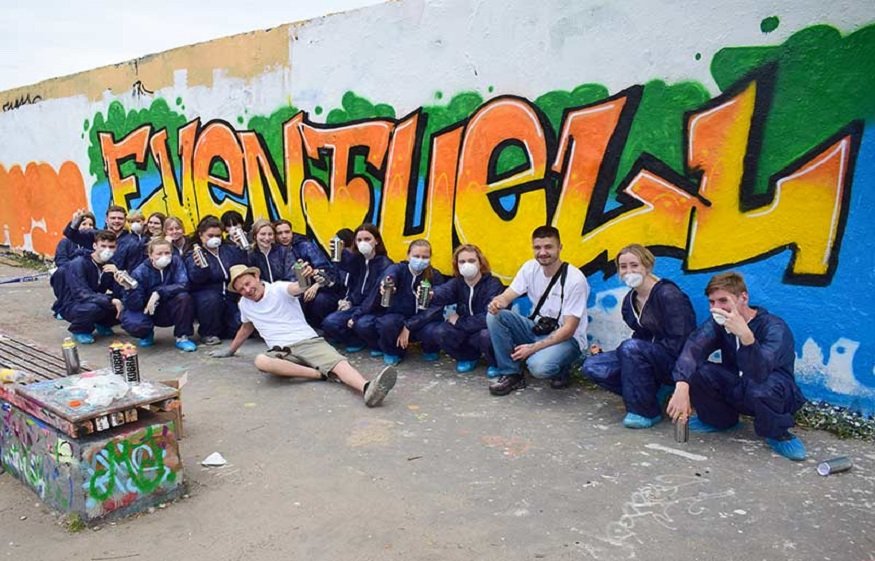
Cities are more than their landmarks
City trips are often built around familiar highlights: museums, historic buildings, popular neighbourhoods and well-known restaurants. Yet the character of a city is often easier to understand through the places and activities that are less formal. Street art and graffiti belong to that part of urban life. They can reveal local creativity, changing neighbourhoods and the way public space is used by artists and communities.
That is one reason graffiti workshops have become an interesting addition to city visits. Instead of only looking at an urban art scene, visitors can spend part of their trip learning how graffiti is made and creating a piece themselves. The experience combines a cultural introduction with a practical activity, giving participants a different perspective on the city they are visiting.
Graffiti gives visitors another view of urban culture
Graffiti is closely associated with cities because the surrounding environment is part of the artwork. A wall, bridge, industrial building or public space can influence the scale, style and visibility of a piece. Walking through an area with graffiti therefore means encountering art in a setting that was not originally designed as a gallery.
Read More : How does prickly heat powder cool you off?
This makes graffiti different from visiting a conventional exhibition. The city itself becomes part of the experience, and the work changes as artists add new pieces or older work disappears. For visitors, that constant change is part of what makes urban art interesting.
Taking a graffiti workshop adds another layer. Participants can learn about lettering, aerosol techniques and composition while thinking about the role graffiti plays in the places they are exploring.
From seeing graffiti to understanding the technique
At first glance, graffiti can appear spontaneous. A finished piece may look as though the artist simply picked up a spray can and started painting. In reality, even relatively simple work involves decisions about line control, spacing, colour, layering and composition.
Spray paint also behaves differently from a brush or pencil. Distance from the surface changes the line, movement affects coverage and different caps create different spray patterns. Once visitors try the material themselves, the skill behind a finished piece becomes much easier to appreciate.
That is one of the strongest reasons to include a graffiti workshop in a city experience. People are not only looking at the finished artwork; they are learning what goes into producing it.
Why Berlin stands out
Berlin offers a particularly strong example of how graffiti and street art can become part of a city’s visual identity. The history of the Berlin Wall, the city’s alternative cultural movements and its large number of urban art projects have all contributed to an environment in which graffiti and street art remain highly visible.
Neighbourhoods such as Kreuzberg and Friedrichshain are widely associated with street art, while areas around the former Wall and other urban spaces provide an important historical context. The city continues to change, however, so its graffiti landscape is not a fixed collection of famous walls. New work appears while older pieces fade, are painted over or disappear with redevelopment.
For visitors, this makes Berlin particularly suitable for a hands-on urban art experience with Graffitifun. A graffiti workshop in Berlin can combine an introduction to graffiti culture with practical spray-painting and lettering techniques in a structured setting.
A workshop creates a different kind of city memory
Travel memories are often connected to places that people have physically experienced rather than simply photographed. A graffiti workshop creates that kind of memory because visitors leave the activity having made something themselves.
The artwork does not have to be technically perfect to be meaningful. What matters is the process of taking an unfamiliar material, learning how it behaves and turning an idea into a visual composition. For many participants, the first controlled line or finished letter becomes part of the memory of the trip.
This is also why graffiti works well for groups. Friends, colleagues, students and families can take part in the same activity while still producing very different results.
What participants actually learn
A well-structured graffiti workshop usually begins with an introduction to the medium and basic spray techniques. Participants may learn how to hold the can, control distance and movement, work with different spray caps and build colour in layers.
Lettering then provides a practical starting point. A name or word can be developed into a personal design by changing the shape and proportions of the letters and adding colour, outlines and other effects. Participants gradually discover that graffiti is not simply about painting quickly; it involves planning and visual decision-making.
The cultural context matters as well. Learning how graffiti developed and how it relates to wider street culture helps visitors understand why names, letters and personal style are such important parts of the art form.
Why this works for modern city trips
They want activities that feel connected to the place they are visiting and give them something to remember afterwards. A graffiti workshop fits naturally into that trend because the activity combines local urban culture with participation.
The format can also work for very different kinds of trips. A group of friends can use it as an afternoon activity, a company can include it in a business trip, and students can combine it with a broader cultural or educational programme.
Professional organisers can also adapt the activity to the group, the city and the available space. That flexibility is particularly useful when graffiti is part of a wider programme rather than the only reason for the trip.
Amsterdam and other European graffiti cities
Berlin is not the only European city where graffiti has become part of the urban experience. Amsterdam, Paris, London, Barcelona and many other cities have developed their own scenes, artists and public artworks.
Each destination offers a different relationship between architecture, local culture and street art. Amsterdam has its own history of alternative and urban culture, while Barcelona is known for the relationship between street art and its distinctive architecture. London has a long and varied graffiti history, and Paris combines contemporary urban art with a much older artistic tradition.
That variety means there is no single European model for a graffiti workshop. The strongest experiences connect the practical activity with the character of the city itself.
The value of learning by doing
One of the biggest advantages of a practical art experience is that information becomes easier to remember when it is connected to an action. Participants can hear about spray control, then immediately test it. They can learn about lettering and then construct their own letters.
This approach also makes graffiti accessible to people who would not normally consider themselves artists. The goal is not to produce identical professional pieces, but to give participants enough knowledge and guidance to experiment with confidence.
The result is a city activity that combines culture, learning and creativity without requiring a previous artistic background.
Graffiti as a bridge between people and places
Graffiti has always been connected to its surroundings. The meaning of a piece can change depending on the neighbourhood, architecture and social history around it. That makes street art a useful way of approaching a city from a contemporary cultural perspective.
A workshop turns that observation into direct participation. Visitors can discover the techniques, talk about the culture and then create something themselves. The city remains the setting, but the participant becomes part of the creative process for a short period.
For people looking for an alternative to conventional sightseeing, that combination can make a city trip more personal and memorable.
A creative way to experience a city
Graffiti workshops have grown beyond their original association with underground street culture and are now used in tourism, education, corporate activities, festivals and private events. Their appeal comes from the fact that they can combine several experiences in one: learning about a culture, trying a new artistic technique and spending time with other people.
That is why the concept works particularly well in cities with an established graffiti or street-art scene. The workshop does not replace exploring the city. It adds another way to understand it.
Read More : Tips To Choose The Best Engraved Wine Decanter
Graffitifun provides graffiti workshops in cities across Europe, including Berlin, and combines practical spray-paint instruction with information about graffiti and street culture.
For visitors, the lasting impression may be more than a photograph of a mural. It can be the memory of standing in an urban setting with a spray can in hand and creating something of their own.