
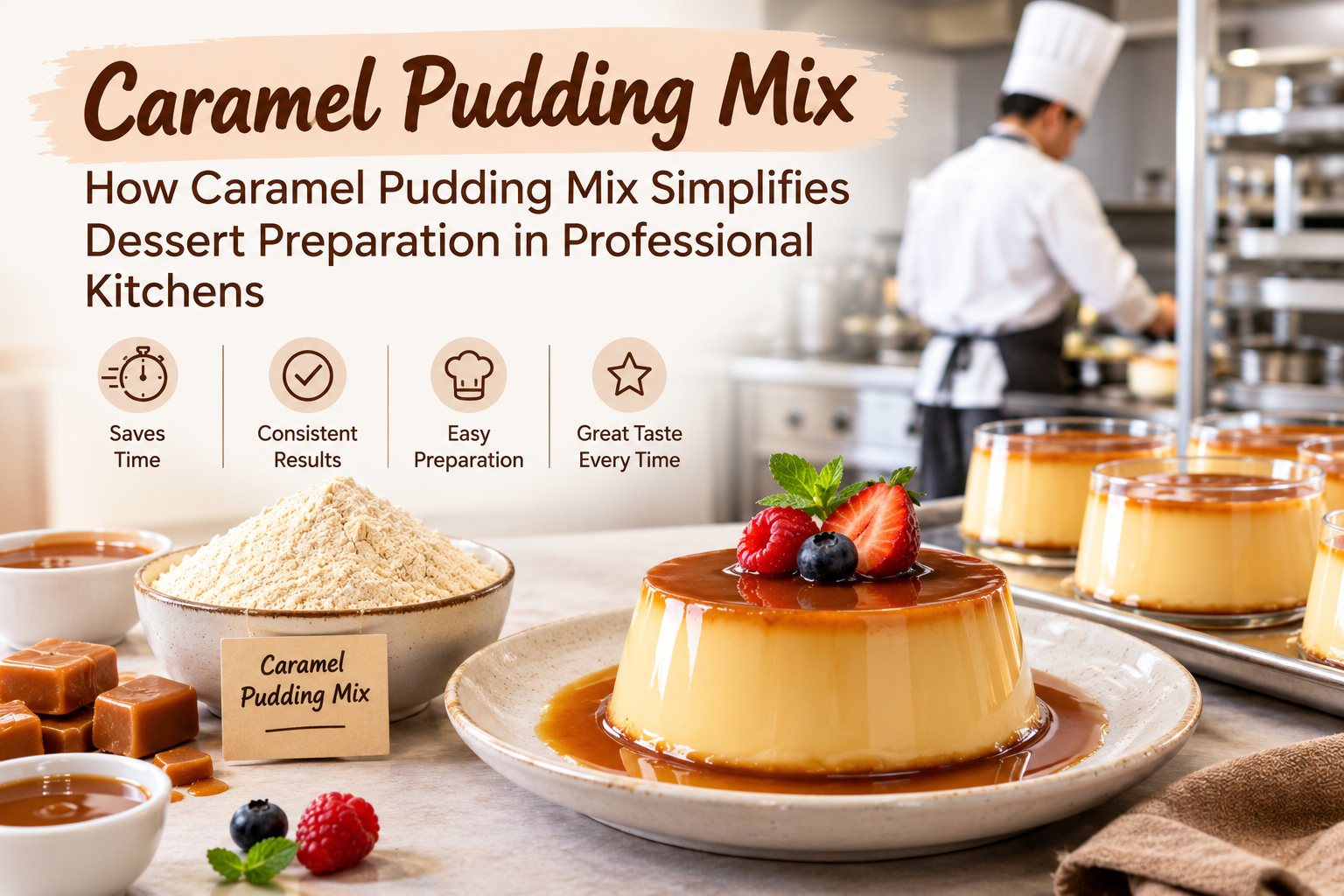
Preparing desserts in large-scale kitchens requires much more than simply using a specific recipe. Apart from following the guidelines, one should keep in mind the timing, quantities, chilling, portioning, and presentation of desserts to ensure the proper flow of the forthcoming events and satisfy the customers. Having similar products on the menu implies the need for standardization, which minimizes the differences between the items.
Caramel pudding is a popular choice for any restaurant, hotel, catering service, or dessert shop. At the same time, preparing several desserts simultaneously involves the risks of undercooking or overcooking, using wrong ingredients, measuring the components imprecisely, or not chilling the puddings enough. Choosing a ready-made mix helps achieve consistent results and standardize the preparation process.
Why Caramel Pudding Requires Careful Preparation
A caramel pudding, also known as flan or creme caramel offers a delectable combination of two types of desserts: a custard base and caramel sauce as a top layer. The key to achieving the right balance is having a perfect blend of the two, so the custard part should not be too firm, and the caramel should not be too thick.
In large-scale kitchens it would require a standardized set of actions for preparing several puddings. For example, the staff might encounter the risks of using different ovens, measuring the ingredients, and pouring the mixture into the molds of various sizes.
Such variations probably would not be visible to untrained eyes. However, the kitchen staff should be aware of these nuances and use standardized instructions for preparing desserts. For large-scale kitchens, it is of particular importance to provide the guests with consistent quality while being able to prepare a certain amount of food.
How Caramel Pudding Mix Supports Kitchen Efficiency
A caramel pudding mix provides a pre-formulated base for preparing the dessert. Depending on the formulation, staff add the specified ingredients and follow the recommended heating, moulding, and setting instructions. This reduces the need to measure and combine every component of the dry formulation separately.
A ready-made custard mix helps establish the standardized procedure since it would be necessary to measure the ingredients and follow the instructions carefully. In addition, it should be possible to prepare a batch of puddings following the same algorithm. Several mixes also provide a reliable solution by offering a no-bake recipe, however, it depends on the formulation and overall requirement by the chef.
In such a manner, a custard powder or a dessert mix for caramel pudding is suitable for large-scale, commercial kitchens. A hospitality business catering for a buffet at a hotel would find the mix helpful because it would be possible to prepare a certain amount of dessert with a known quantity of ingredients and the appropriate portions. It might also help to simplify the process of training the staff since the caramel pudding mix will already have standardized the preparation process. For instance, the cooks will be able to rely on the specific instructions, measure the required amounts of each ingredient, add them in a particular order, and use the proper tools. Thus, the preparation would remain consistent across all the staff. Moreover, it would become much easier to make the necessary adjustments to the preparation process if something went wrong instead of attempting to guess the cause-effect relationships.
Managing Batch Production and Portion Control
Preparing desserts in advance in batches enables the kitchen staff to spread their work in the less busier periods rather than at the time of service. The portioning of the caramel pudding can be divided depending on the menu and presentation needs, for example, individual moulds or into serving dishes.
Moreover, standardised portioning aids in controlling the amount of food being served and can aid the kitchen in portioning in accordance to how many portions can be expected from a batch, which is significant in catering organisations where the number of guests is known in advance. In addition, in restaurants, individual portions can make the process of plating and presenting easier as well as avoid any last-minute cutting or serving of the desserts.
Keeping a record of the production can aid the kitchen staff in knowing what should be changed or adjusted next time around. The staff can keep a track of the number of batches made, time taken, mould size and type of chilling used. If a batch does not turn out as it was expected, this record can act as a guideline rather than randomly experimenting with different combinations.
Furthermore, the number of portions needed in a particular period should be considered when deciding on a number of batches to be prepared. Making too many can tie up a lot of space in the kitchen’s storage, and making too few can lead to rushing into making another batch when there is an unexpected increase in customers. Keeping a record of past sales in comparison to present and future bookings can aid the kitchen in keeping a balance between the staff, time, and resources required while preparing desserts.
Fitting Caramel Pudding into a Varied Dessert Menu
A practical dessert menu should provide variety while minimally interfering with the operation of the kitchen. Such a menu can include preparing a custard base using a caramel pudding mix which can be incorporated in various types of layered cakes, mousse, entremets and other cold desserts with different consistencies and flavors.
In addition, when choosing desserts, priority should be given to those that are easiest to prepare with the available equipment. Some require baking, while others may need to be prepared in advance or on the day of preparation. For example, the dessert menu can include both classic milk-based pudding, such as mahalabia, and other, more complex desserts. This allows the chef to take into account local preferences in the menu planning.
Crème brûlée offers another contrast through its baked custard and caramelised sugar topping, and a crème brûlée mix may be used when planning a separate preparation workflow for that dessert. Although both desserts involve custard-style textures, their preparation and finishing requirements are not interchangeable.
When selecting desserts for the same menu, chefs should consider how each item will be stored, portioned, and finished. A combination of chilled puddings, baked desserts, and freshly assembled options can provide variety, provided the kitchen has sufficient space and staff to manage their different requirements.
Storage, Chilling and Service Considerations
Desserts made ahead of time will need to be stored appropriately, particularly if they are made with milk or any other perishable goods. Caramel pudding needs to be prepared in line with the preparation instructions and the correct food-safety protocols for the kitchens. The amount of the space in the refrigerators needs to be considered in advance of starting the production of desserts, particularly when there are multiple desserts to be chilled at the same time.
Read More: Water Softeners for Bathroom: Do You Really Need One?
Moulds need to be filled evenly, labelled as necessary, and placed in such a way so that staff can get at the portions without disturbing the other prepared desserts. Throughout the service, crews should follow the appropriate temperature-control procedures and refrain from leaving their chilled desserts at room temperature for longer than necessary.
As per presentation, whether it is left in the mould, turned out on to a plate or given in an individual portion, the shape of the portion should match and the ratio of custard to caramel should be right. Crews should make sure that the pudding can be removed from the moulds as required, while the caramel has been spread to their liking. These simple checks help to ensure good presentation for each individual portion of pudding.
Making Dessert Preparation More Manageable
In professional kitchens, the correct preparation of desserts can be secured through the establishment of proper recipes, job organization, equipment, and timing. While a standard mixture can be prepared in advance to simplify the process, its proper consistency and final preparation mode should be defined by the chefs.
Read More: How a Graffiti Workshop Changes the Way You Experience a City
In particular, the preparation of caramel pudding can be standardized by determining the appropriate portions, preparation technology, and time needed for setting to ensure the proper texture. As a result, the dessert can be introduced to the menu more frequently, while the chefs retain flexibility in terms of their presentation and combinations.