
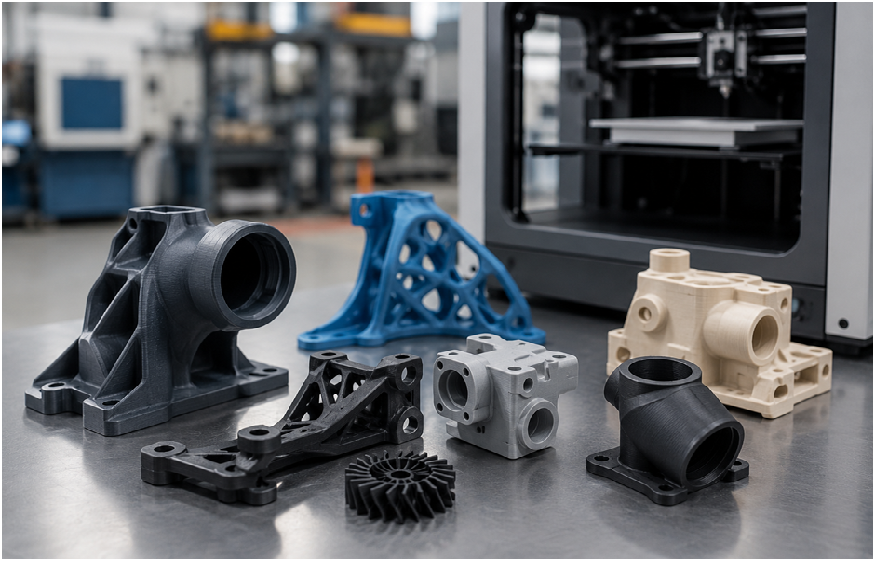
The manufacturing landscape across Queensland is undergoing a significant transformation. From aerospace component suppliers in Eagle Farm to medical device manufacturers in Bowen Hills, a growing number of industrial businesses are replacing traditional fabrication methods with additive manufacturing. The shift is not merely a trend — it is a strategic response to mounting pressures around cost efficiency, lead time reduction, supply chain fragility, and the demand for greater design complexity. At the centre of this evolution is the 3D print revolution, and Brisbane is quickly becoming one of its most active hubs in the southern hemisphere.
The Traditional Manufacturing Problem
For decades, Brisbane’s manufacturing sector has relied on conventional subtractive processes — CNC machining, injection moulding, casting, and sheet metal fabrication — to produce parts and components. While these methods remain effective for high-volume, standardised production, they present considerable limitations in today’s agile, demand-driven economy.
Tooling costs for injection moulding can run into tens of thousands of dollars before a single part is produced. Lead times for custom components from overseas suppliers often stretch to eight to sixteen weeks. Design iterations require new tooling, adding further cost and delay. For small-to-medium enterprises (SMEs) operating in competitive markets, these constraints represent a serious bottleneck.
Read More: Christian Wedding Gift Ideas: Personalized Canvas Wall Decor for 2026 Weddings
3D printing in Brisbane offers a fundamentally different paradigm — one that is increasingly difficult for forward-thinking manufacturers to ignore.
Why Is Demand for 3D Printing Services Rising in Brisbane?
1. Reduced Time-to-Part
One of the key reasons manufacturers choose professional 3D printing services is the significant reduction in production lead times. A component that would traditionally require three to six weeks from design approval to delivery can now be produced in hours or days using additive manufacturing.
This speed advantage is particularly valuable in industries such as mining equipment, defence supply chains, and food processing machinery — all sectors with a strong presence in the greater Brisbane region. When a critical machine component fails, waiting weeks for a replacement is not operationally viable. A local 3D printing Brisbane provider can produce functional replacement parts rapidly, minimising costly downtime.
2. Elimination of Tooling Costs
Traditional manufacturing processes require significant upfront investment in moulds, dies, and fixtures before production begins. These tooling costs are only justifiable when production volumes are high enough to amortise the expense.
With additive manufacturing, there is no tooling. A digital CAD file is loaded directly into the printer, and production begins. This makes 3D printing in Brisbane economically viable for low-volume, high-complexity parts — a common requirement across industries like robotics, custom automation equipment, and specialised agricultural machinery.
3. Design Freedom and Geometric Complexity
Additive manufacturing processes are not constrained by the same geometric limitations as machining or moulding. Features such as internal lattice structures, conformal cooling channels, organic geometries, and undercuts can be produced without additional cost or process steps.
Brisbane engineers are leveraging this design freedom to create components that are not only functional but structurally optimised. Topology-optimised brackets, lightweight structural inserts, and complex fluid manifolds are now produced routinely through local 3D printing services — designs that would be prohibitively expensive or physically impossible to achieve through conventional means.
4. Supply Chain Resilience
The global supply chain disruptions of the early 2020s exposed significant vulnerabilities in Australia’s industrial supply chains. Manufacturers relying on imported components from Asia and Europe faced severe delays, stockouts, and escalating logistics costs.
Read More: What Should You Check Before Installing a Water Softener at Home?
3D printing Australia-wide — and specifically in Brisbane — provides a pathway to supply chain sovereignty. By digitising part inventories and producing components on demand through a local 3D printing service, manufacturers can dramatically reduce their dependence on overseas suppliers. The concept of “digital inventory” — storing a part as a file rather than a physical stock item — is gaining serious traction among Brisbane procurement and operations managers.
Materials Capability: Beyond Plastic
A common misconception is that 3D printing is limited to plastic prototypes unsuitable for real-world industrial applications. This could not be further from the truth in today’s advanced additive manufacturing environment.
Engineering-Grade Polymers
Modern 3D printing services in Brisbane offer a broad range of high-performance thermoplastics, including:
- PEEK (Polyether Ether Ketone): High-temperature resistance, chemical inertness, suitable for aerospace and medical applications.
- Nylon PA12 and PA12-CF (Carbon Fibre reinforced): Excellent mechanical properties, wear resistance, and dimensional stability for functional end-use parts.
- ASA and ABS: UV-stable and impact-resistant materials suitable for outdoor industrial applications.
- TPU (Thermoplastic Polyurethane): Flexible, abrasion-resistant components such as seals, gaskets, and grommets.
Metal 3D Printing: A Game Changer for Heavy Industry
Perhaps the most significant advancement in additive manufacturing for Brisbane’s manufacturing sector is the rise of metal 3D printing. Technologies such as Direct Metal Laser Sintering (DMLS), Selective Laser Melting (SLM), and Binder Jetting now enable manufacturers to produce solid metal components with mechanical properties that match or even surpass those achieved through conventional machining or forging.
Materials available through metal 3D printing include:
- 316L and 17-4PH Stainless Steel — for corrosion-resistant components in food, marine, and chemical processing applications.
- Ti-6Al-4V Titanium — lightweight, high-strength parts for aerospace, defence, and medical implants.
- AlSi10Mg Aluminium — lightweight structural components and heat exchangers.
- Inconel 625 and 718 — nickel superalloys for high-temperature environments such as turbines and exhaust systems.
- Tool Steel (H13, M2) — for moulds, dies, and wear-resistant tooling inserts.
Metal 3D printing is enabling Brisbane manufacturers in the aerospace, mining equipment, defence, and energy sectors to produce complex metal parts that previously required either extensive machining from solid billet or costly investment casting processes.
Industry-Specific Applications Across Brisbane
Aerospace and Defence
Queensland has a growing aerospace manufacturing and maintenance, repair, and overhaul (MRO) sector centred around Brisbane Airport and surrounding precincts. Additive manufacturing is being used to produce flight-eligible structural brackets, ducting components, cabin interior fittings, and ground support equipment parts — often leveraging metal 3D printing for structural applications and high-performance polymers for non-structural assemblies.
Mining and Resources Equipment
Mining OEMs and equipment maintenance contractors operating out of Brisbane and serving Queensland’s extensive resources sector are using 3D print technology for producing replacement wear parts, custom brackets, fluid system components, and operator interface housings — particularly where original equipment manufacturers no longer stock legacy parts.
Medical and Healthcare Devices
Brisbane’s expanding medical technology sector is utilising 3D printing services for patient-specific implant trials, surgical guide production, prosthetic components, and custom medical device housings. Biocompatible materials and the ability to produce patient-specific geometries make additive manufacturing uniquely suited to this industry.
Architecture, Construction, and Industrial Design
Custom architectural fixtures, building prototype models, and specialist construction hardware are increasingly produced through 3D printing in Brisbane, particularly where low quantities and complex shapes make traditional fabrication economically impractical.
Comparing 3D Printing to Traditional Manufacturing Methods
| Factor | Traditional Manufacturing | 3D Printing Service |
| Tooling Cost | High (moulds, dies, fixtures) | None |
| Lead Time | 3–16 weeks | Hours to days |
| Minimum Viable Quantity | High (to amortise tooling) | 1 unit |
| Design Changes | Costly and time-consuming | Free digital revision |
| Geometric Complexity | Limited by process constraints | Near-unlimited |
| Material Waste | High (subtractive processes) | Low (additive process) |
| Supply Chain Risk | High (import dependency) | Low (local production) |
The Role of Local 3D Printing Services in Brisbane’s Manufacturing Ecosystem
The growth of accessible, professional 3D printing services within Brisbane has been a critical enabler of this manufacturing shift. Rather than requiring capital investment in in-house equipment — which carries significant costs in machinery, materials, maintenance, and skilled operator training — manufacturers can access bureau-style 3D print services on demand.
A capable 3D printing service provider in Brisbane will typically offer:
- Design for Additive Manufacturing (DfAM) consultation — helping engineers optimise part geometry for 3D printing.
- Multi-technology capability — FDM, SLA, SLS, MJF, DMLS/SLM across both polymer and metal platforms.
- Post-processing — machining, surface finishing, anodising, heat treatment, and quality inspection.
- Materials certification — for regulated industries such as aerospace and medical devices.
- Rapid prototyping through to end-use production — supporting the full product development lifecycle.
This service model means even small manufacturers and engineering firms in Brisbane can access capabilities previously available only to large industrial corporations.
3D Printing Australia: A National Perspective
While this article focuses on 3D printing in Brisbane, it is important to acknowledge the broader national context. The adoption of additive manufacturing is growing across 3D printing Australia-wide, driven by government initiatives supporting advanced manufacturing, industry investment in digital transformation, and the emergence of nationally distributed 3D printing service networks.
Australia’s geographic isolation and the high cost of air freight have historically made local manufacturing capacity particularly valuable. As 3D printing technology matures and material costs decline, the economic case for on-shore additive manufacturing production continues to strengthen. Brisbane, as Australia’s third-largest city and a gateway to Asia-Pacific supply chains, is well positioned to become a leading centre of additive manufacturing capability nationally.
Key Considerations When Engaging a 3D Print Service Provider
For Brisbane manufacturers exploring additive manufacturing for the first time, or looking to scale existing 3D print capabilities, the following factors are critical when evaluating a service provider:
Technology Breadth: Ensure the provider offers the process and material combination appropriate to your application — not all 3D printing technologies are suited to all applications.
Quality Systems: Look for ISO certification, documented quality management systems, and material traceability — particularly for metal 3D printing applications in regulated industries.
In-House Post-Processing: A provider capable of handling machining, surface finishing, and testing under one roof reduces coordination overhead and shortens total lead time.
Engineering Support: Access to experienced application engineers who can advise on design optimisation, material selection, and process suitability is invaluable.
Local Presence: A Brisbane-based provider reduces shipping time, freight cost, and communication friction — and supports the local manufacturing economy.
Conclusion
The shift toward 3D printed parts among Brisbane manufacturers is not a passing phenomenon — it is a structural evolution in how industrial components are designed, produced, and supplied. Driven by the need for speed, flexibility, cost efficiency, and supply chain resilience, additive manufacturing is delivering measurable competitive advantage to manufacturers across Queensland and beyond.
Whether leveraging polymer 3D printing for functional prototypes and production jigs, or adopting metal 3D printing for high-performance end-use components, Brisbane’s manufacturing community is increasingly recognising that additive manufacturing is not a replacement for all traditional processes — but it is an indispensable addition to the modern manufacturing toolkit.
For Brisbane manufacturers yet to fully explore what a professional 3D printing service can offer, the time to act is now. The companies investing in additive manufacturing capability today are the ones that will define the competitive benchmark for the decade ahead.